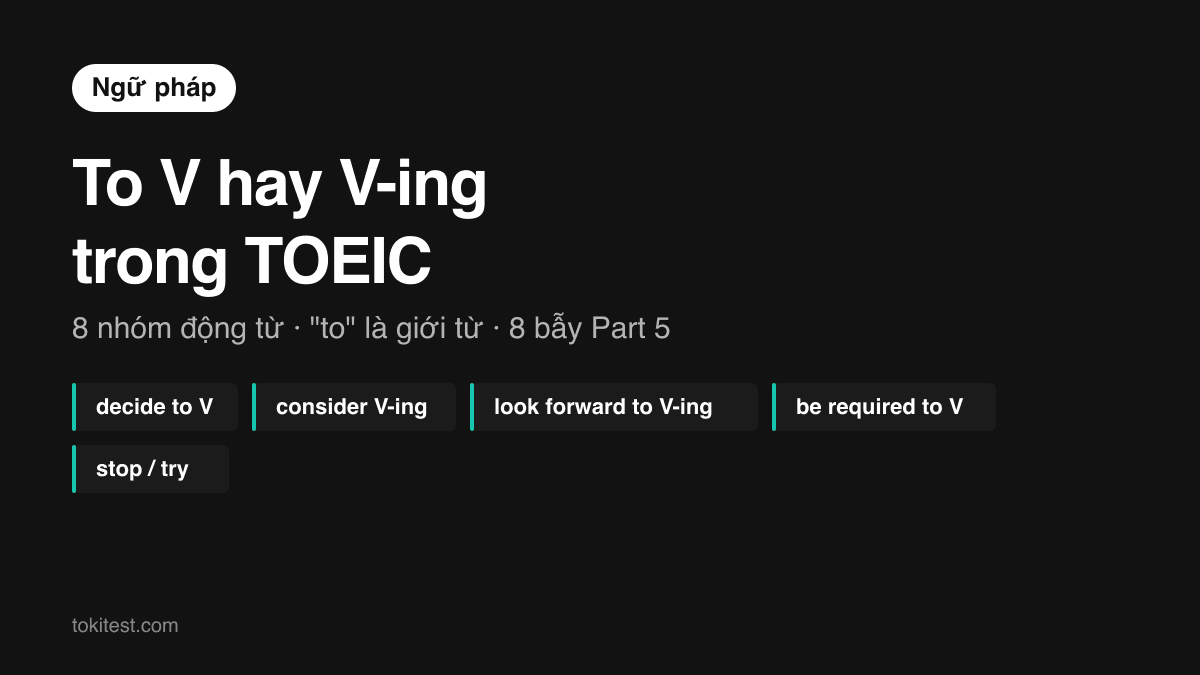
"Look forward to hear hay hearing?", "recommend to book hay booking?". Câu hỏi to V hay V-ing là dạng ngữ pháp mà người học TOEIC sai nhiều nhất sau dạng từ, vì nó không có một quy tắc chung: mỗi động từ đi với một dạng riêng. Tin tốt là TOEIC chỉ lặp lại một nhóm vài chục động từ và cụm từ quen thuộc. Bài viết này gom chúng thành 8 nhóm để bạn nhớ theo nhóm thay vì từng từ, kèm 8 bẫy Part 5 và 10 câu tự kiểm tra.
TOEIC hỏi to V và V-ing theo những cách nào?
- Sau một động từ: The company decided ______ (to expand / expanding).
- Sau một giới từ, kể cả khi giới từ đó là "to": We look forward to ______ (meet / meeting) you.
- Sau tân ngữ: The manager asked the staff ______ (to submit / submitting).
- Sau tính từ hoặc cụm cố định: be eligible to, have difficulty, be worth…
Đáp án nhiễu thường gồm đủ bốn dạng của cùng một động từ: submit / to submit / submitting / submitted. Vì vậy bước đầu tiên luôn là nhìn từ đứng ngay trước chỗ trống.
Nhóm 1: Động từ + to V
Phần lớn là động từ nói về ý định, kế hoạch, mong muốn hướng tới tương lai:
- Dự định, quyết định: plan, intend, aim, decide, choose, arrange, prepare, expect, hope, wish, want, need
- Đồng ý, từ chối, hứa: agree, refuse, promise, offer, volunteer, threaten
- Cố gắng, thành công, thất bại: attempt, strive, seek, manage, fail, afford, hesitate
- Khác: tend, appear, seem, deserve, wait, claim
The firm plans to open a branch in Da Nang. · We strive to respond within 24 hours. · Please do not hesitate to contact us.
Nhóm 2: Động từ + V-ing
Thường là động từ nói về việc đang diễn ra, đã xảy ra, hoặc đang được cân nhắc:
- Cân nhắc, đề xuất: consider, suggest, recommend, propose (= đề xuất), discuss, anticipate
- Trì hoãn, dừng, tránh: delay, postpone, avoid, finish, quit, discontinue, resist
- Bao gồm, liên quan: include, involve, mention, risk
- Thích, ghét, phiền: enjoy, mind, dislike, appreciate, can't help
- Tiếp tục, luyện: keep, practice, deny, admit, miss
We recommend booking early. · The board is considering relocating the headquarters. · Would you mind sending the file again?
Nhóm 3: Động từ + tân ngữ + to V (và dạng bị động)
Đây là nhóm TOEIC hỏi nhiều nhất trong email và thông báo nội bộ:
- ask, advise, allow, permit, enable, encourage, expect, invite, persuade, remind, require, request, urge, instruct, authorize, force
Chủ động: The policy requires employees to wear badges.
Bị động: Employees are required to wear badges. Các cụm be required to, be encouraged to, be advised to, be expected to, be invited to xuất hiện ở hầu như mọi đề.
Lưu ý: allow, permit, advise, recommend đi với V-ing khi không có tân ngữ. The museum does not allow taking photos nhưng The museum does not allow visitors to take photos.
Nhóm 4: Động từ đi với cả hai, nghĩa khác nhau
| Động từ | + to V | + V-ing |
|---|---|---|
| remember / forget | nhớ / quên phải làm (việc chưa làm): Remember to lock the door. | nhớ / quên đã làm: I remember sending the invoice. |
| stop | dừng lại để làm việc khác: He stopped to answer the phone. | thôi không làm nữa: The store stopped selling printers. |
| try | cố gắng: We tried to fix the error. | thử (xem có hiệu quả không): Try restarting the computer. |
| regret | lấy làm tiếc phải thông báo: We regret to inform you… | hối tiếc đã làm: She regrets missing the meeting. |
| mean | định: I meant to call you. | có nghĩa là: Expanding means hiring more staff. |
We regret to inform you that… là câu mở đầu thư từ chối kinh điển trong Part 6 và Part 7. Còn begin, start, continue, prefer, like đi với cả hai mà nghĩa gần như không đổi, nên TOEIC hiếm khi hỏi.
Nhóm 5: "To" là giới từ → + V-ing
Đây là nhóm bẫy kinh điển. "To" trong các cụm sau là giới từ, nên theo sau phải là danh từ hoặc V-ing:
- look forward to, be committed to, be dedicated to, be devoted to
- be used to, be accustomed to, get used to (quen với)
- object to, be opposed to, contribute to, lead to
- in addition to, with a view to, when it comes to, prior to
- the key to, an approach to, a solution to
We look forward to working with you. · The company is committed to reducing its carbon emissions. · Prior to joining the firm, she worked in Tokyo.
Mẹo kiểm tra: thử thay V-ing bằng một danh từ. Look forward to the meeting đúng → "to" là giới từ → dùng V-ing. Decide to the meeting sai → "to" là một phần của to V.
Nhóm 6: Giới từ khác + V-ing
Mọi giới từ đều đi với V-ing: before, after, by, without, upon, instead of, in charge of, responsible for, interested in, capable of, thank you for.
Please read the manual before operating the machine. · She is responsible for ensuring that orders ship on time. · Upon arriving, guests should check in at reception.
Nhóm 7: Tính từ + to V và cụm cố định + V-ing
- Tính từ + to V: be able / unable to, be eligible to, be likely to, be willing / reluctant to, be eager to, be ready to, be pleased to, be sure to, be about to
- Cụm cố định + V-ing: have difficulty (in), spend time / money, be worth, be busy, there is no point (in), it's no use
Only full-time staff are eligible to apply. · Many customers had difficulty logging in. · The exhibition is worth visiting.
Nhóm 8: Động từ nguyên mẫu không "to"
- make / let / have + tân ngữ + V: The manager had the assistant book the flights.
- help + (tân ngữ) + (to) V: This tool helps teams (to) track their progress. Cả hai đều đúng.
- Sau động từ khuyết thiếu: can, should, must, will, may + V.
- Sau would rather, had better: You had better arrive early.
Tám bẫy to V / V-ing ở Part 5
1. Look forward to + V-ing
We look forward to ______ your feedback on the new design. (receive / receiving / received / be received)
→ receiving. "To" là giới từ.
2. Recommend / suggest không đi với to V
The consultant suggested ______ the launch until spring. (to postpone / postponing / postpone / postponed)
→ postponing. Ngoài V-ing, suggest / recommend còn đi với that + S + V nguyên mẫu: suggested that the launch be postponed.
3. Be committed to + V-ing
Harbor Hotels is committed to ______ an exceptional experience for every guest. (provide / providing / provided / provision)
→ providing. provision là danh từ nhưng thiếu mạo từ và không đi được với tân ngữ an exceptional experience.
4. Be required to + V
All visitors are required ______ a safety briefing before entering the site. (attend / to attend / attending / attended)
→ to attend.
5. Allow + tân ngữ + to V
The new scheduling system allows managers ______ shifts more efficiently. (assign / to assign / assigning / assigned)
→ to assign, vì có tân ngữ managers.
6. Stop + to V hay V-ing
Due to low demand, the factory has stopped ______ the older model. (to produce / producing / produce / produced)
→ producing (thôi sản xuất). stopped to produce nghĩa là "dừng lại để sản xuất", vô lý trong ngữ cảnh.
7. Giới từ by / before / without + V-ing
Customers can save 10 percent by ______ their orders online. (place / to place / placing / placed)
→ placing.
8. Chỉ mục đích: to V, không phải for + V-ing
Ms. Park called the supplier ______ the delivery date. (confirming / to confirm / for confirm / confirmed)
→ to confirm. Mục đích của hành động dùng to V hoặc in order to V; for chỉ đi với danh từ (for confirmation).
Bài tập tự kiểm tra (10 câu)
- The company has decided ______ its customer service hours. (extend / to extend / extending)
- We appreciate ______ the time to complete this survey. (you take / your taking / you to take)
- Employees are encouraged ______ the training sessions. (attend / to attend / attending)
- Thank you for ______ our annual conference. (attend / to attend / attending)
- Please remember ______ your badge before leaving the building. (return / to return / returning)
- The supervisor had the technicians ______ the equipment twice. (inspect / to inspect / inspecting)
- Mr. Diaz is used to ______ long hours during the busy season. (work / working / worked)
- The museum does not permit ______ inside the galleries. (eat / to eat / eating)
- Only registered members are eligible ______ the discount. (receive / to receive / receiving)
- The board will consider ______ the budget at next month's meeting. (revise / to revise / revising)
Đáp án: 1. to extend · 2. your taking · 3. to attend · 4. attending · 5. to return · 6. inspect · 7. working · 8. eating · 9. to receive · 10. revising.
Câu 2 là dạng nâng cao: appreciate đi với V-ing, và chủ thể của V-ing dùng tính từ sở hữu (your taking). Câu 7: be used to (quen với) + V-ing, khác used to + V (đã từng). Câu 8: permit không có tân ngữ nên đi với V-ing.
Câu hỏi thường gặp
Có quy tắc chung nào để đoán to V hay V-ing không?
Có một xu hướng: to V hay đi với động từ hướng tới tương lai (plan, hope, decide, promise), còn V-ing hay đi với việc đang diễn ra hoặc đã xảy ra (enjoy, finish, avoid, consider). Đây chỉ là gợi ý để đoán khi bí, không thay được việc nhớ các nhóm ở trên.
Nên học bao nhiêu động từ?
Với mục tiêu 600–750, nắm chắc nhóm 3 (động từ + tân ngữ + to V), nhóm 5 ("to" là giới từ) và khoảng 15 động từ mỗi nhóm 1, 2 là đủ cho phần lớn câu trong đề. Học chúng trong câu ví dụ, không học dạng danh sách khô.
V-ing sau giới từ có phải là danh động từ không?
Đúng. V-ing đứng sau giới từ, làm chủ ngữ (Recycling saves money) hay làm tân ngữ của enjoy, avoid… đều là danh động từ (gerund). TOEIC không hỏi tên gọi, chỉ hỏi bạn chọn đúng dạng.
Dạng câu này thường xuất hiện cùng câu hỏi từ loại và giới từ ở Part 5. Khi luyện trên Luyện Đọc của Toki, mỗi câu sai có diễn giải vì sao chọn to V hay V-ing; hãy đánh dấu những câu bạn sai để làm lại sau vài ngày, đến khi chọn đúng mà không cần nghĩ.