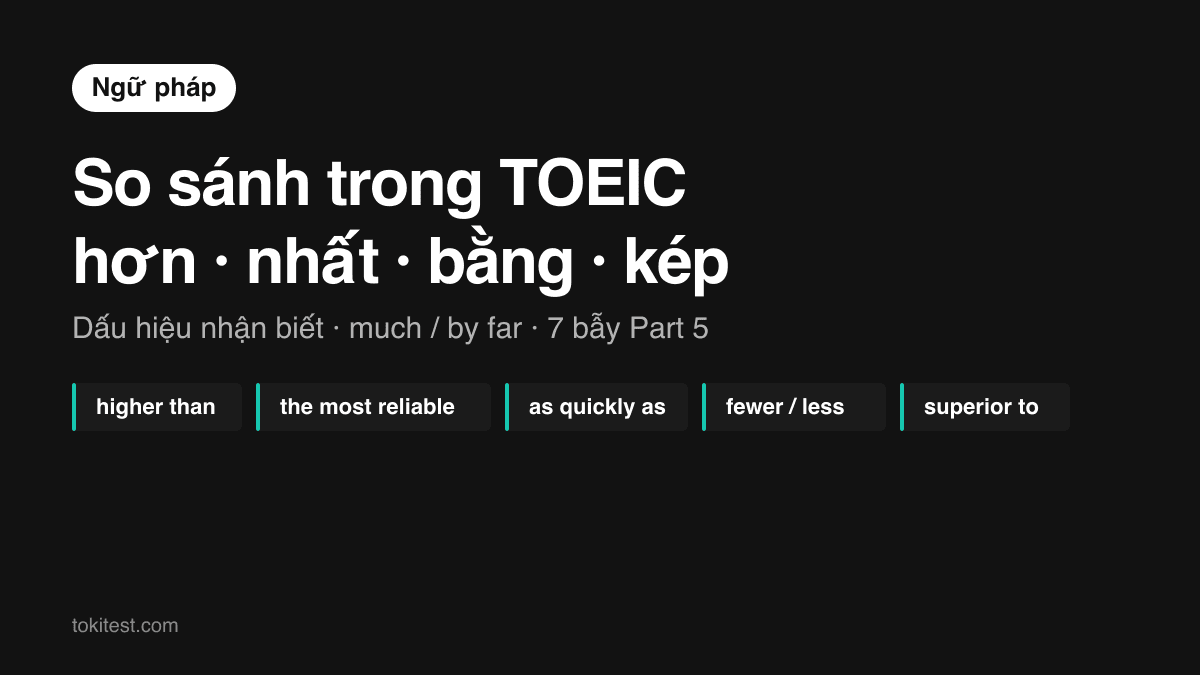
So sánh là dạng ngữ pháp "dễ ăn điểm" nhất ở Part 5 TOEIC: quy tắc ít, dấu hiệu nhận biết rõ ràng, chỉ cần nhìn một từ trong câu là biết đáp án thuộc dạng nào. Vậy mà nhiều người vẫn mất điểm vì chọn very trước so sánh hơn, dùng than sau superior, hay nhầm less với fewer. Bài viết này tóm gọn mọi dạng so sánh TOEIC hay hỏi, 7 bẫy điển hình và 10 câu tự kiểm tra có đáp án.
Dấu hiệu nhận biết: nhìn một từ, biết ngay dạng so sánh
| Thấy trong câu | Cần dạng | Ví dụ |
|---|---|---|
| than | So sánh hơn (-er / more / less) | Sales were higher than expected. |
| the … of / in / ever / yet / available | So sánh nhất (the -est / the most) | the most reliable supplier in the region |
| as … as | Dạng nguyên (không đuôi -er) | as quickly as possible |
| the + so sánh hơn …, the + so sánh hơn | So sánh kép | The sooner you register, the more you save. |
| the … of the two | So sánh hơn có "the" | the larger of the two rooms |
| one of the + danh từ số nhiều | So sánh nhất | one of the busiest airports |
Với Part 5, chỉ riêng bảng này đã giải được phần lớn câu so sánh. Khi các đáp án là high / higher / highest / highly, hãy dò tìm than, the, as quanh chỗ trống trước khi đọc nghĩa.
Cách tạo dạng so sánh
- Tính từ, trạng từ ngắn (1 âm tiết, hoặc 2 âm tiết tận cùng -y): thêm -er / -est: cheap → cheaper → cheapest; busy → busier → busiest; early → earlier → earliest.
- Tính từ dài: more / most: efficient → more efficient → most efficient.
- Trạng từ đuôi -ly: more / most: quickly → more quickly. Ngoại lệ hay gặp: soon → sooner, fast → faster, hard → harder, late → later.
- Bất quy tắc: good / well → better → best; bad / badly → worse → worst; many / much → more → most; little → less → least; far → farther / further → farthest / furthest.
- So sánh kém: less / least + tính từ: less expensive, the least crowded.
Lưu ý further trong TOEIC thường mang nghĩa "thêm, hơn nữa" chứ không phải khoảng cách: for further information, further details, until further notice.
Từ bổ nghĩa cho so sánh: much, far, by far…
- Trước so sánh hơn: much, far, even, still, a lot, considerably, significantly, substantially, slightly, a little.
This model is significantly lighter than the previous one. - Không dùng very trước so sánh hơn: very cheaper là sai.
- Trước so sánh nhất: by far, easily, the very: This is by far the most popular item. · the very best.
- Sau so sánh nhất: ever, yet, to date, possible, available: the largest order we have ever received.
- Trước as … as: twice, three times, half, nearly, just, almost: twice as large as last year.
Những cấu trúc so sánh hay xuất hiện trong văn bản TOEIC
- than expected / than anticipated / than usual / than ever / than before: Attendance was lower than anticipated.
- more / fewer / less + danh từ + than: fewer complaints, less time, more applicants.
- more than / less than / over + con số = hơn, dưới: more than 200 participants.
- the same + danh từ + as, similar to, different from, compared to / with, in comparison with.
- superior / inferior / senior / junior / prior / preferable + to (không dùng than): Our service is superior to that of our competitors.
- as + tính từ / trạng từ + as possible: as soon as possible, as accurately as possible.
Bảy bẫy so sánh ở Part 5
1. "As … as": chọn tính từ hay trạng từ?
The new printer works as ______ as the old one but uses less ink. (quiet / quietly / quieter / quietest)
Giữa as … as luôn là dạng nguyên. Còn tính từ hay trạng từ thì bỏ as … as đi để xét: works quietly (bổ nghĩa động từ works) → quietly. So sánh với The new printer is as quiet as the old one: sau is cần tính từ.
2. Very trước so sánh hơn
The revised proposal is ______ more detailed than the first draft. (very / much / most / so)
→ much. Very chỉ đứng trước tính từ nguyên (very detailed).
3. Thấy "of the two" vẫn chọn so sánh nhất
Of the two candidates, Ms. Choi is the ______ qualified. (more / most / much / many)
Chỉ có hai đối tượng → so sánh hơn có the → more.
4. Superior to, không phải superior than
The durability of the new material is superior ______ that of conventional plastic. (than / to / from / as)
→ to. Cũng lưu ý cụm that of: so sánh độ bền với độ bền, không phải độ bền với nhựa.
5. Fewer hay less?
This quarter, the help desk received ______ complaints than in any previous quarter. (less / fewer / little / least)
complaints là danh từ đếm được số nhiều → fewer. Less đi với danh từ không đếm được: less paperwork, less time.
6. So sánh nhất với "ever" và thì hiện tại hoàn thành
The spring sale generated the ______ revenue the store has ever recorded. (high / higher / highest / highly)
Có the trước chỗ trống và ever phía sau → highest.
7. So sánh kép: "the + so sánh hơn, the + so sánh hơn"
The earlier you submit your application, the ______ your chances of securing a spot. (good / better / best / well)
Vế đầu The earlier… báo hiệu so sánh kép → better.
So sánh trong Part 7: đọc kỹ chiều so sánh
Part 7 hay đặt câu hỏi dựa trên câu so sánh: Sales in March were 15 percent lower than in February → đáp án đúng có thể là "Doanh số tháng 2 cao hơn". Bẫy nằm ở việc đảo chủ thể so sánh, nên khi gặp câu hỏi What is indicated about…, hãy xác định rõ cái gì hơn cái gì trước khi chọn. Các từ như exceed, surpass, outperform, fall short of, decline là dạng paraphrase của so sánh hơn mà Part 7 rất thích dùng.
Bài tập tự kiểm tra (10 câu)
- Our new delivery service is ______ than the previous one. (fast / faster / fastest / more fast)
- The Lakeside branch is the ______ of our three locations. (busy / busier / busiest / more busy)
- Please respond as ______ as possible. (prompt / promptly / more promptly / most promptly)
- This year's conference attracted ______ more visitors than last year's. (very / considerably / most / so)
- Of the two plans, the second is the ______ expensive. (less / least / fewer / little)
- The quality of this fabric is ______ to that of cheaper brands. (better / superior / higher / greater)
- The project took ______ time than we had planned. (fewer / less / little / least)
- Mr. Ito is one of the most ______ engineers in the department. (experience / experienced / experiencing / experiences)
- The more customers we serve, the ______ feedback we receive. (much / more / most / many)
- For ______ information, please visit our Web site. (far / further / furthest / farther)
Đáp án: 1. faster · 2. busiest · 3. promptly · 4. considerably · 5. less · 6. superior · 7. less · 8. experienced · 9. more · 10. further.
Câu 8 là bẫy kết hợp từ loại: sau the most và trước danh từ cần tính từ (experienced), không phải danh từ. Câu 5: chỉ có hai kế hoạch nên dùng so sánh hơn less, không phải least.
Câu hỏi thường gặp
Mỗi đề TOEIC có bao nhiêu câu so sánh?
Thường 1–2 câu Part 5 hỏi trực tiếp, chưa kể các câu trong Part 6 và Part 7 cần hiểu đúng quan hệ so sánh. Số câu không nhiều nhưng đây là dạng gần như chắc chắn lấy điểm nếu nắm dấu hiệu nhận biết.
Tính từ hai âm tiết thêm -er hay dùng more?
Tính từ 2 âm tiết tận cùng -y thêm -er (easier, busier). Các tính từ 2 âm tiết khác phần lớn dùng more (more modern, more careful). TOEIC hiếm khi bắt bạn chọn giữa hai cách này; hầu hết câu hỏi xoay quanh nhận diện dạng so sánh.
"The most" và "most" khác nhau thế nào?
The most + tính từ là so sánh nhất. Most + danh từ (không có the) nghĩa là "phần lớn": Most employees work remotely on Fridays. Còn most of the + danh từ là "phần lớn trong số".
So sánh là một trong những dạng câu nằm trong nhóm ngữ pháp Part 5 có thể giải bằng dấu hiệu thay vì đọc cả câu. Áp dụng cách làm đó vào chiến thuật Part 5, rồi luyện thêm trên Luyện Đọc của Toki để xem diễn giải cho từng câu sai.